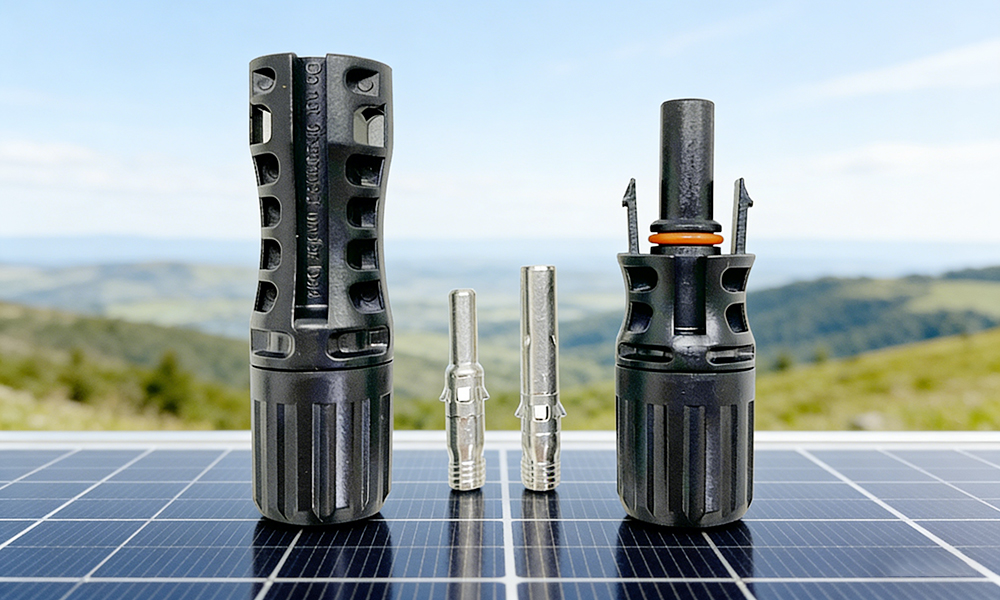
Between the grand photovoltaic arrays and sophisticated inverters, and on the back of each photovoltaic module gleaming with a blue luster, lies a component that seems tiny yet is vitally important—the PV connector. It is neither the energy source nor the control core of the system, but it serves as the "energy joints" and "safety valves" that ensure the entire photovoltaic system operates efficiently, safely, and for the long term. Understanding its multiple roles is the key to grasping the essence of photovoltaic system design and operation & maintenance (O&M).
The primary and most intuitive role of PV connectors is to serve as a physical and electrical bridge for electrical energy transmission.
1. Module-level Interconnection: They connect individual photovoltaic modules in series to form strings with higher output voltage, acting as an essential link for constructing the basic power generation units of the system.
2. System-level Integration: They efficiently connect strings to combiner boxes and then to inverters, building a complete electrical path from DC power generation to AC grid connection.
3. Modularity & Flexibility: Their plug-and-play design greatly simplifies on-site installation, system expansion, and later module replacement processes, serving as the foundation for modular and standardized deployment of photovoltaic systems.
If a photovoltaic system is likened to a living organism, connectors are its critical "nervous system nodes", and their safety and reliability are directly related to the system's survival.
1. Preventing DC Arcing and Fires: This is their core safety function. High-quality connectors ensure no abnormal high temperature at contact points during high-current transmission through low and stable contact resistance, excellent material flame retardancy (e.g., UL94 V-0), and tight physical latches. Conversely, poor-quality or aged connectors with loose contact are prone to sustained DC arcing (temperatures up to several thousand degrees Celsius), which is one of the main causes of fires in photovoltaic power plants.
2. Withstanding Severe Environmental Conditions: Exposed to the outdoors for long periods, connectors must endure harsh conditions such as UV radiation, high/low temperatures, rain, sandstorms, and salt spray. Their high protection rating (typically IP67/IP68) and UV-resistant aging shells effectively prevent internal corrosion or short circuits caused by moisture and dust intrusion, safeguarding electrical insulation and personal safety.
3. Providing Reliable Electrical Isolation: Well-designed connectors, paired with cables, offer safe insulating encapsulation for high-voltage DC electricity to prevent accidental electric shock.
In the current pursuit of overall system efficiency (Levelized Cost of Energy, LCOE), minor differences in connector performance will accumulate over years and amplify into significant power generation losses.
1. Minimizing Conduction Losses: The internal metal contacts (typically silver-plated copper) and precision structural design of connectors aim to reduce contact resistance to an extremely low level (usually less than 0.5 mΩ). The tiny resistance at each connection point, over series circuits and decades of operation, results in cumulative power losses that cannot be ignored. High-quality connectors are a key component in reducing system line losses and increasing effective power generation.
2. Ensuring Long-Term Performance Stability: The electrical conductivity, oxidation resistance of materials, and long-term retention of mechanical structures determine whether contact resistance can remain stable over a lifecycle of more than 25 years. Performance degradation is directly equivalent to the loss of power generation revenue.
The photovoltaic system's design life of over 25 years requires every component to have equivalent durability. Connectors act as one of the "shortest planks" in the "barrel effect" here.
1. Mechanical Reliability: Its locking structure must resist stresses from long-term wind vibration and thermal expansion/contraction to prevent accidental disconnection. A robust outer shell needs to protect the internal core from mechanical damage.
2. Environmental Durability: Materials must withstand long-term UV exposure without embrittlement and extreme temperatures (-40℃ to +120℃) without failure, ensuring a lifespan matching that of photovoltaic modules.
3. Operational & Maintenance (O&M) Accessibility: When the system requires inspection or maintenance, standardized and reliable connectors facilitate quick disconnection and reconnection, serving as the foundation for ensuring high system availability.
PV connectors have another unique and non-negotiable role in the system – enforcing system compatibility. International electrotechnical standards (e.g., IEC 62852) and industry consensus clearly stipulate: intermating connectors of different brands or models within the same photovoltaic system is strictly prohibited!
Even if they look similar, differences in tolerances, materials, and internal designs between different brands may lead to increased contact resistance, overheating, and waterproof failure, ultimately causing malfunctions or even fires. Therefore, by design, connectors act as "standardization guardians" to ensure the consistency of electrical interfaces within the system, compelling designers and O&M personnel to ensure the purity and matching of connections in the entire circuit from the source.
In summary, PV connectors are far more than simple "plugs". They serve as the hub for efficient transmission, the gateway of safety defense lines, the detail guaranteeing efficiency, the cornerstone of long-term reliability, and the enforcer of the iron rule for system compatibility.
The quality of their performance and the adequacy of maintenance are directly reflected in the power generation, safety, O&M costs, and ultimate return on investment (ROI) of photovoltaic power plants.
When building and operating a photovoltaic power plant, giving strategic attention and investment to this "small component" is undoubtedly one of the wisest decisions to ensure that the grand green energy project stands firm on a solid foundation for a long time.

 telephone
 Contact US