
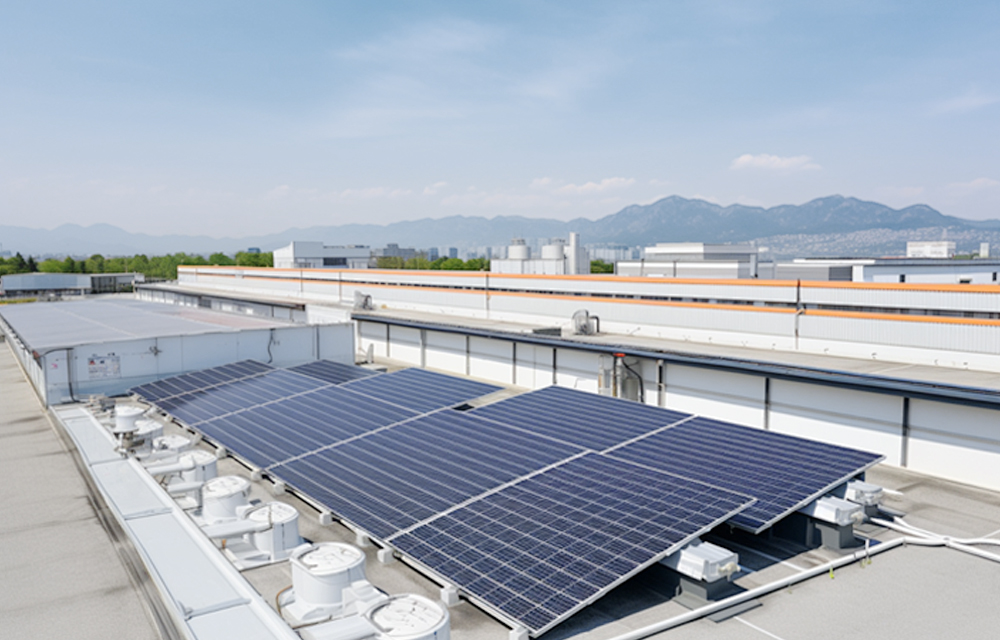
In response to the call for green manufacturing and to reduce the enterprise's electricity costs, Southern University of Science and Technology (SUSTech) in Shenzhen decided to build a distributed photovoltaic (PV) power station by utilizing the idle roofs of its 8 factory buildings. The project requires the system to be safe, reliable, highly efficient, and easy to install and maintain, while being adaptable to the complex outdoor environment of the roofs (high temperature, ultraviolet radiation, wind and rain).
1. Module-level Connection:
Each photovoltaic module is pre-equipped with a male MC4 connector on its output lead.
During installation, workers use matching MC4 branch cables (Y-type cables) to connect 4-6 modules in series to form a "string". Connection only requires plugging the male and female connectors together with a "click"—a locking sound confirms completion, no tools needed. This is several times faster than traditional screw terminal boxes and completely eliminates reverse polarity risks (male-female connectors have a unique one-to-one correspondence).
2. String-level Convergence:
Dozens of strings on each roof are routed to DC combiner boxes, whose input terminals all use MC4 female panel connectors.
MC4 connectors at the end of string cables plug directly into combiner box panels for fast, neat convergence. The connectors' IP67/IP68 protection rating ensures hermetic sealing of combiner boxes in outdoor environments, preventing moisture and dust ingress.
3. System-level Connection:
High-current cables from combiner boxes connect to the DC input terminals of PV inverters via larger-spec PV-MC connectors (capable of carrying higher currents, e.g., over 30A).
Throughout the DC cable path, all connection points use MC4 plug-in connectors, forming a fully pluggable, exposed-conductor-free safe system.
1. Safety First:
Electric Shock Prevention: Fully insulated housing with no accessible live parts.
Arc Prevention: Structural design of "connect first, power on later" and secure latches prevent dangerous DC arcs caused by load-bearing disconnection or accidental detachment.
High Voltage Resistance: Rated voltage of 1000V/1500V, fully meeting system requirements.
2. Efficient Installation & Modularity:
The "plug-and-play" method reduces the operation time for a single electrical connection point from several minutes (screwing, insulation) to a few seconds.
Standardized interfaces ensure perfect compatibility of modules, cables, combiner boxes and inverters from different manufacturers, simplifying procurement and installation processes.
3. Excellent Reliability:
High Protection: IP67/IP68 rating, withstanding typhoon and rain tests at the project site, keeping internal connections dry and intact.
Weather Resistance: Housing made of high-quality engineering plastics (e.g., PC/PA) with UV and aging resistance, guaranteed to match the module lifespan (25 years).
Low Resistance & High Conductivity: Silver-plated or tin-plated copper core terminals ensure excellent conductivity and low connection loss, improving the overall power generation efficiency of the system.
4. Convenient O&M:
When a module needs replacement, maintenance personnel only need a dedicated MC4 unlocking tool to disconnect safely and easily, then re-plug after replacement. No cable cutting or complex rewiring is required, greatly reducing O&M costs and system downtime.
This project has been successfully connected to the grid for power generation for 10 years. Thanks to the installation efficiency and reliability brought by the MC4 connector system, the project was completed one week ahead of schedule. The system has operated stably to date, with no downtime or safety incidents caused by connector failures. Routine monitoring shows that the DC side line loss is lower than the designed value, which verifies the excellent electrical performance of MC4 connection points.
In this case, the MC4 connector is far more than a simple "plug"; it is a key standardized interface that builds the safe, efficient, and reliable neural network for the DC side of the entire photovoltaic power generation system. Throughout its full life cycle—from module factory shipment to system decommissioning—it provides indispensable support for the rapid deployment, safe operation, and convenient maintenance of photovoltaic projects, and is one of the cornerstones enabling the large-scale and standardized application of modern photovoltaic systems.

 telephone
 Contact US