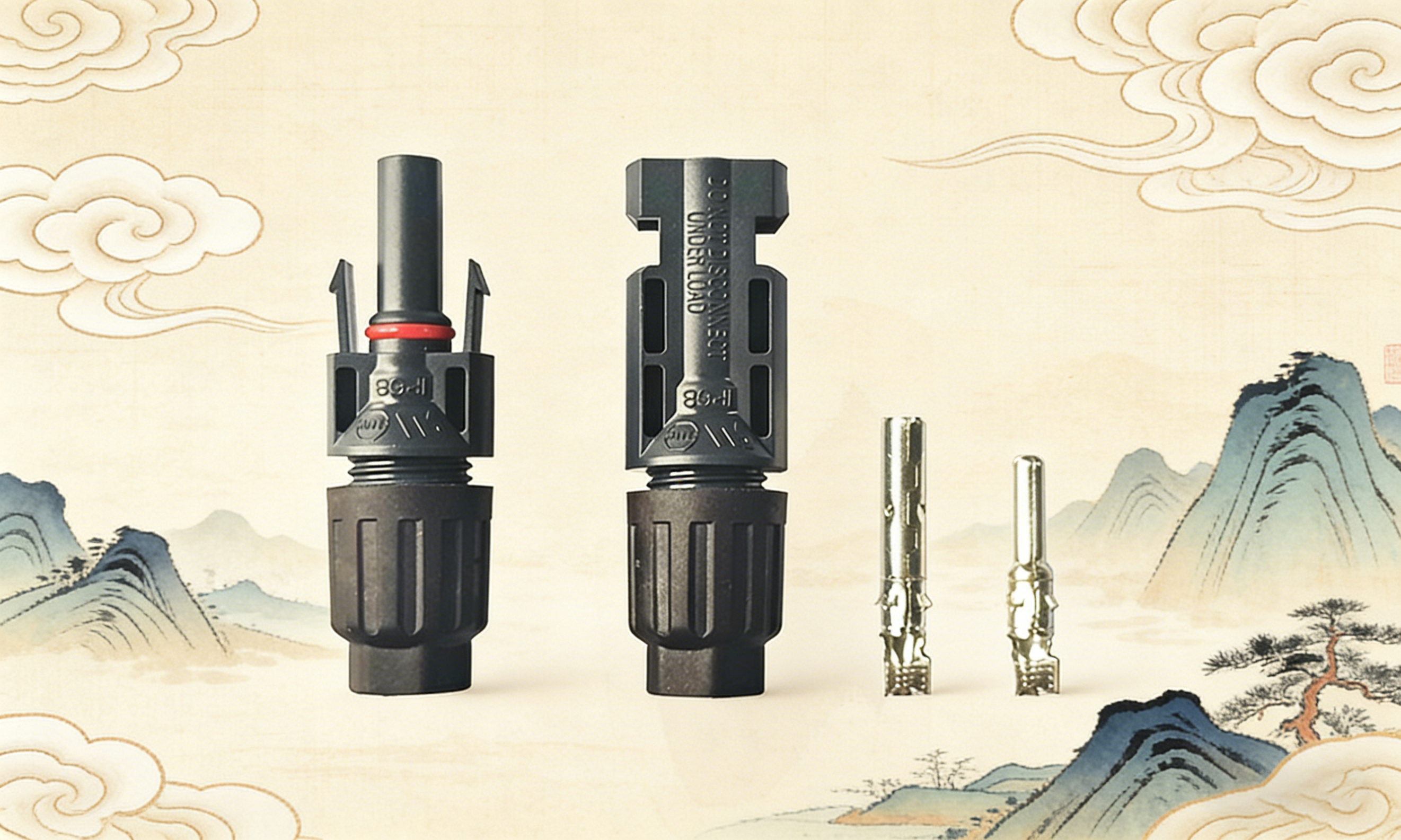
In large-scale PV power plants and common rooftop solar panel arrays, people often focus on the shining PV modules or high-efficiency inverters. However, between each module and in the connections linking modules to inverters, there is a small yet critical component. Acting like 'joints' and 'throats' throughout the system, it quietly ensures safe and efficient energy transmission – this is the PV connector.
A PV connector is an electrical connection device specially designed for solar photovoltaic power generation systems. It is mainly used to quickly and reliably connect circuits between PV modules (solar panels), as well as link string modules to inverters, combiner boxes and other equipment. Its core mission is to conduct DC power safely and with low loss over the long term under harsh outdoor environments.
Unlike ordinary household plugs and sockets, PV connectors are special foolproof, sealed and latching devices, usually used in pairs (male and female). Currently, the mainstream model in the global PV market is MC4 originally developed by a German company and its compatible products ('MC' stands for multi-contact, '4' means conductor cross-section is about 4mm²). MC4 has become the de facto standard interface in the industry.
Safety Guardian: PV systems continuously generate high-voltage DC power under sunlight. The primary responsibility of connectors is to prevent electric shock risks and DC arc fires caused by poor contact or water ingress. High-quality connectors feature excellent insulation, flame retardancy and high-voltage resistance.
Efficiency Gateway: The quality of metal conductors and contacts inside connectors directly affects resistance. Excessively high contact resistance causes power loss in the form of heat, which can seriously account for 1% or more of system power generation – a considerable loss over the long term.
Reliability Cornerstone: PV systems are designed for a service life of more than 25 years, requiring long-term resistance to wind, sun, rain, frost, UV radiation, high temperature, high humidity and cyclic temperature changes. Connectors must have exceptional weather resistance, anti-aging properties and mechanical durability to ensure stable connections and effective sealing throughout their lifecycle.
Installation & Maintenance Hub: Their 'plug-and-play' design greatly simplifies on-site wiring, installation, later maintenance and module replacement, improving project efficiency.
A qualified PV connector usually includes:
Housing: High-grade engineering plastics (such as PPO, PA) with excellent UV resistance, high temperature resistance (usually >120℃) and flame retardancy (UL94 V-0).
Seal: Rubber sealing ring (usually silicone or EPDM) providing IP67/IP68 dustproof and waterproof protection to ensure long-term outdoor sealing.
Metal Contacts: High-conductivity, corrosion-resistant plated copper alloy (such as tinned copper, silver-plated copper) to ensure low contact resistance and good current carrying capacity.
Latching Mechanism: Reliable mechanical lock design to prevent accidental disconnection due to vibration or tension, requiring special tools for unlocking to enhance safety.
Key electrical parameters include rated voltage (commonly 1000V, 1500V or higher), rated current (commonly 30A, 40A, 50A, etc.), maximum conductor cross-section (for 4mm², 6mm² cables, etc.) and contact resistance (required to be extremely low, usually less than 0.5 mΩ).
The global PV connector market consists of a few well-known international brands (such as Stäubli, Amphenol, TE Connectivity, etc.) and many domestic qualified manufacturers. Be wary of low-cost inferior products, as they often pose major hidden dangers to system faults and safety.
Core Selection Principles:
Complete Certifications: Always choose products certified by international authorities such as TÜV, UL, IEC 62852. These certifications are the basic guarantee of safety, performance and durability.
Brand & Quality: Prioritize reputable brands to ensure reliable materials and workmanship.
Proper Matching: Use the same brand and model of connectors within the same PV system, especially in the same string. Mixing different brands is strictly prohibited. Differences in size, tolerance and elastic materials can cause a sharp rise in contact resistance, overheating, sealing failure or even burnout.
Professional Crimping: Connectors must be crimped to cables with professional crimping tools to ensure firm connections and low resistance – a critical construction step for long-term reliability.
With the development of PV technology, connectors are also evolving:
Higher Voltage & Current: Adapt to 1500V+ systems and high-power modules, carrying higher current.
Smarter: Integrated micro-sensors for online monitoring of temperature, resistance and other statuses, early warning of potential faults, moving toward 'intelligent connection'.
Material Innovation: Development of new, more weather-resistant and eco-friendly materials.
Although PV connectors are not the most valuable part of a PV system, they are the 'lifeline' that connects all core components and ensures unobstructed energy flow. Their quality and installation directly affect the power generation revenue, operational safety and long-term stability of the power plant. When building a PV system, paying 'great attention' to this 'small component', choosing reliable products and performing standard installation is a wise move to protect the safety and efficient operation of PV assets from the source.

 telephone
 Contact US